Showing posts with label sewing. Show all posts

Wednesday, January 19, 2011

crochet hook clutch tutorial {get organized}

I've been carrying my crochet hooks around in a plastic bag for some time now. When they started escaping through little holes in the bag, I knew it was time for me to finally make that crochet hook organizer I've been meaning to make for the last two years. I loooove the way it turned out! I keep opening and closing it, running my fingers over the row of shiny hooks. It feels so good to be organized for once in my life! It's going to make crocheting so much easier now that I won't be digging through my bag for the right hook. Here's how to make your own crochet hook organizer clutch and get organized!


Crochet Hook Organizer {Tutorial}

Supplies:
*2 pieces of fabric cut 16.5" x 7.5" for clutch
*2 pieces of lightweight fusible interfacing (I used Pellon Val-u-fuse)
*1 piece of fabric cut 10" x 12" for hook pockets
*1 piece of fabric cut 2" x 1.5" for yarn needle pocket
*Elastic (I used a child's hair elastic)
*Button or fabric-covered button and tool
*Fabric marking pen or chalk
*Coordinating thread and sewing machine
*Iron and ironing board
*Scissors

1. Iron interfacing to back of each 16.5" x 7.5" pieces according to interfacing's instructions.


2. With wrong sides together, lay a dinner plate on the short edge of the two pieces. Trace around the edge of the plate to create the rounded edge of the clutch. Cut along your line.


2. Fold and iron the 10" x 12" piece of fabric in half lengthwise, so it's now 5" x 12". Lay this piece on the inside piece of the clutch body along the bottom, straight (not rounded) edge, with the raw edge along the bottom of the clutch body. Pin in place.


3. Lay your crochet hooks out on this piece to see how many pockets you need. Using a ruler, draw a line with your marking pen or chalk to mark the where you'll stitch lines between each hook to create hook pockets. Below are sample sizes I used for my pockets. I made them quite snug so they wouldn't fall out when the clutch was folded up. I also included a spot for my little scissors, and a couple of extra spots for duplicate hooks (I have two of a few hook sizes).


N - 3/4"
K - 3/4"
J - 5/8"
I - 5/8"
H - 1/2"
G - 1/2"
F - 3/8"
E - 3/8"
D - 3/8"
C - 3/8"
7mm or smaller - 1/4"
Scissors - 1"

4. Take the piece you cut for your yarn needle pockets and fold under and iron each edge 1/4". Measure and mark your lines for your needles. My lines were marked about 1/8" from each other, with a slightly larger spot for a stitch marker to fit. Pin to inside piece of clutch near the rounded edge.


5. Stitch each marked line to create your pockets. Be sure to fold under the right side edge and stitch it close to the edge. Don't worry that the left hand edge and bottom of the hook pockets are still open--you'll close them up in the next step.


6. Time to sew on your button. Take the other piece of 16.5" x 7.5" fabric and fold over the straight-edge side 6". Fold the rounded edge over. This will help you see where to place your button. Your button should be about 1/4" from the rounded edge (remember that there will be a 1/4" seam allowance when you sew the body together, so the button will end up being 1/2" away from your rounded edge). You can use a regular button, or create a coordinating button with a covered button kit and a little fabric. Stitch your button in place.


7. Next, pin your two pieces of the case together with right sides together. Pin your elastic band in place in the center of the curved edge. I folded my clutch up first to make sure it was going to be the right length to reach the button.


Be sure to leave a 3" opening on the top edge for turning your clutch right-side out!


8. Stitch around the edges using a 1/4" seam allowance. I stitched and backstitched over the elastic a few times to make sure it was secure.


9. Clip your corners and turn right-side out through your 3" opening.


Fold in your 3" opening so the edges are flush. Iron flat.


10. Top-stitch around the entire case, close to the edge. This will close your 3" opening.


Load your hooks, scissors, and needles, fold it up and button it closed, and you're organized! Ahhhh. . .


Now I just need to come up with a good way to organize all my yarn that is taking over the family room!


Wednesday, January 5, 2011

going through my stash {and making snuggies for kids!}

My husband has a New Year's resolution for me: de-stash my craft stash! I have to agree--it needs to be done before we move across the country this summer. So started with the yards of University of Utah fleece I bought on sale and finally made my kids the knock-off Snuggies (you know, the blankets with sleeves?) I promised them! Perfect for snuggling up and playing their new Wii.


I found a great pattern for the kid-sized Snuggie (or Snuglet) here and made a few modifications. Since my kids are young, they needed a smaller size. I changed the length of the fleece piece to 50" for my 7-year-old and 45" for my 5-year-old. Measure your child from shoulder to the floor and add a few inches for a custom fit. I also measured their arms and trimmed some length off them, too.

Secondly, I moved the arm holes up about 5 inches. They gave me more length and less bulk around their necks. Lastly, I added a strip of Velcro to the back so they would stay closed while they were wearing them. They kept walking around and complaining they were falling off (they don't stay sitting down for very long!).

We're Huskies now, and soon we'll be Hawkeyes, but we'll always be Utes (we've given them way too much money not to be loyal!). So of course we've already started indoctrinating our children. The leftover fabric was plenty to make them simple scarves and little pillows, so they can dream about their future college years at the greatest school on earth.


I noticed Hancock's Fabrics has licensed school fleece and cottons on sale this week, so go make a Snuggie and start showing your school spirit while lounging on the couch!


Sunday, January 2, 2011

vintage pillowcase apron you can really use {sewing tutorial}

Happy New Year!! Hope you all had a safe and happy end to 2010. I was folding laundry and listening to a book on my iPod when the new year hit (while everyone else in my house slept), but hey, that's my life right now and I'm happy with it! The best part was waking up to Anne of Green Gables on PBS--my husband turned it on to wake me up. I did wake up, but his plan was foiled when I stayed in bed to watch it all morning. 2011 is bound to be a good year with that start! (I know, I'm a nerd, but I'm not afraid to admit it!)

I'm so excited to start the year off with a fabulous and quite ingenious tutorial from the fabulous and ingenious Jennifer. It's a pillowcase apron with an inventive addition. You're going to want to run right out and make it. Good thing it's a holiday weekend!

Pillowcase Apron with Towel Tutorial


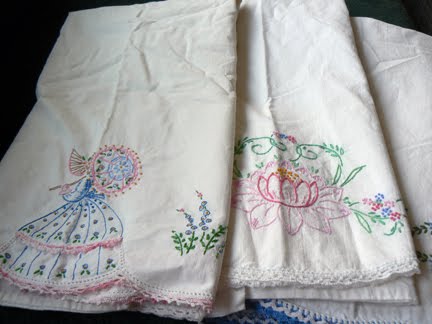
When my mother was downsizing her house last spring, she gave me a whole stack of old embroidered pillowcases. I really loved them, but I knew that I wouldn’t be using them for pillows. I already have a whole stack of them that I was given when I got married that I’ve never used. Last spring I saw a friend wear an apron to work that was made from an embroidered pillowcase. I loved it and knew right away what I was going to be doing with that stack of pillowcases. I made this apron for my newly married daughter, who is living in Germany. She loves blue and I knew that she would really like to have one of her grandmother’s pillowcases.


I used this tutorial by Crafty Dame to make the apron. It was really fast and pretty easy, although if I make another one I am going to make the waistband (not the ties) a little bigger and have less gathering in the skirt. It took just about an hour to make it.


My husband teases me that my life is always form over function (he’s an engineer). While it is true that I tend to make things more pretty than functional, it’s not always the case. I knew while I was making this apron that it would be hard to use in the kitchen because I wouldn’t want to get it dirty. I also know that I am always looking for a kitchen towel to wipe my hands or wipe up messes, so I decided to add a kitchen towel to this apron.

I sewed buttons to the waist band of the apron. I tried to make them match the embroidery. I didn’t worry too much about the size because I wanted them to be a decorative element if you didn’t have the towel attached.


I used a bar mop which I folded over about 5 or 6 inches and sewed button holes into it.


The bar mop just buttons on and off over the apron and is perfect for wiping hands, cleaning up messes, protecting the apron from grease and can even be used as a hot pad in a pinch. When it gets dirty just unbutton it and throw it in the washer. The bar mop is not anywhere near as pretty as the apron, but I thought it made the apron a lot more functional.


Flirty Aprons


Related Posts Plugin for WordPress, Blogger...